How to Price Your Services as a Brand Designer: The Complete Brand Design Pricing Guide

Let me guess: you opened a spreadsheet, typed in a number, immediately decided that number was both offensively low and suspiciously high, and then spent 45 minutes looking at what other designers charge. Oh, and somehow you still have no idea what to put in the proposal.
Been there. Truly.
Pricing your services as a brand designer can feel like trying to solve a math problem where half the numbers are missing, somebody keeps whispering “know your worth,” and Adobe just renewed for another month, but good pricing isn’t about pulling a number out of thin air or copying the designer whose Instagram bio says “six-figure creative.” It’s about understanding what your business needs, how you work, what your clients are actually paying for, and which pricing structure makes the most sense for you.
So, let’s break it down. No business-bro energy. Just practical advice for setting rates that make sense and leave you with enough money to keep buying the emotional-support matcha.
First: stop asking what everyone else charges
I get it. You want a benchmark. You want someone to slide into your DMs and say, “The correct price for a logo is exactly $2,743.19, you’re welcome.”
Unfortunately, that’s not how this works. A designer living at home with minimal expenses, taking on their first few clients, and offering simple logo packages isn’t operating the same business as a studio owner covering contractors, software, taxes, insurance, and six years of experience.
Even if their Instagram grids look equally cute. Your pricing needs to reflect your business, your capacity, and the actual scope of your work, not whatever somebody posted in a “how much I made this month” carousel. Looking at industry rates can be a useful context. Using someone else’s pricing as your entire business strategy? Slightly more questionable.
Step 1: figure out what your business actually needs to make
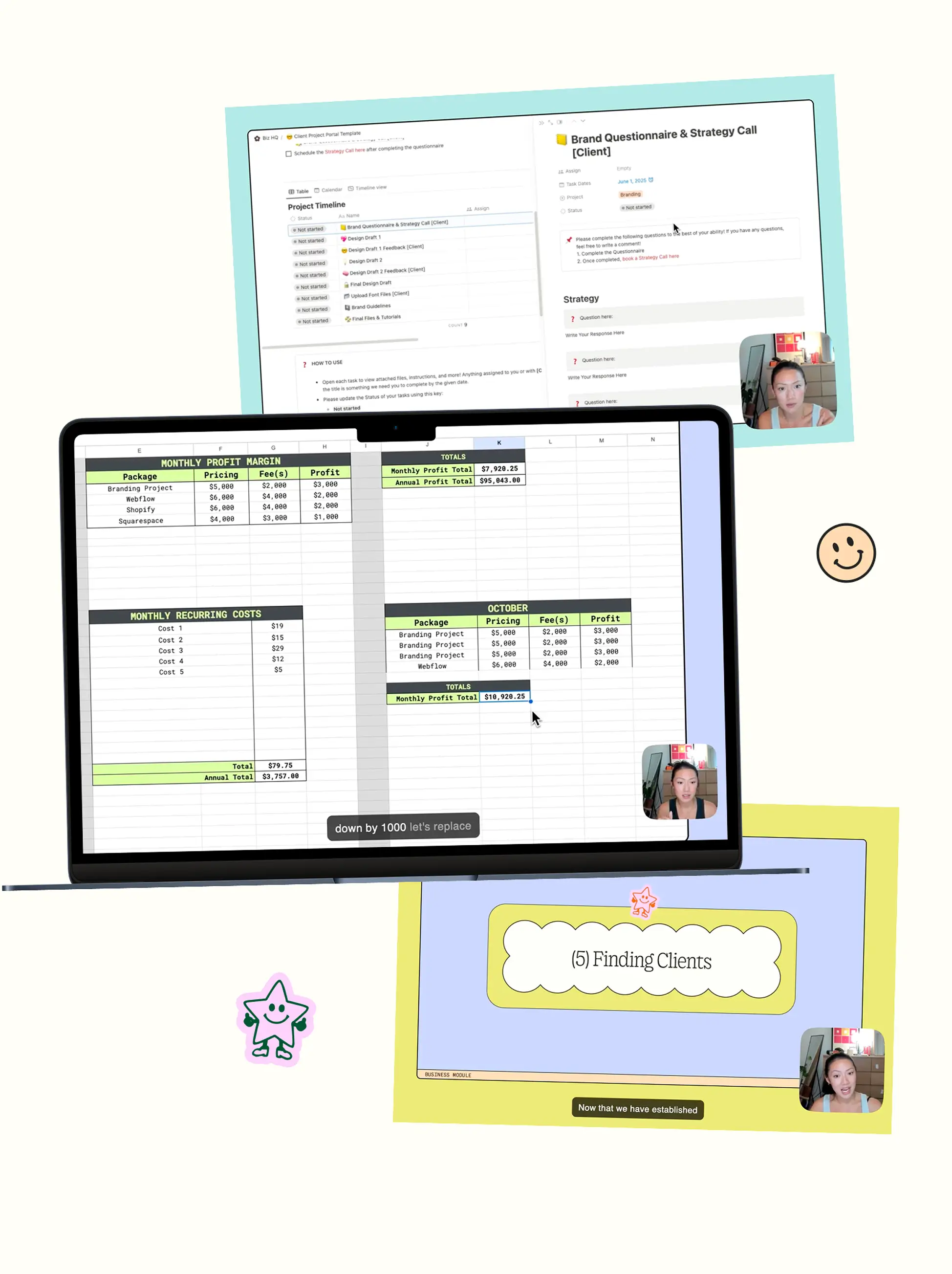
Before you can decide what to charge for a project, you need to understand how much money your business needs to bring in and no, we’re not only counting the money you want to transfer into your personal account. Your business has expenses, too. Annoying of it, but true.
Consider:
- Your desired income or owner pay.
- Business expenses, like Adobe, Figma, website hosting, client management software, and contractors.
- Taxes and other required contributions.
- Savings, profit, professional development, and an emergency buffer.
- Time off, slower seasons, and the fact that you’re a person who occasionally needs to close their laptop.
Let’s say you want your business to support:
- $60,000 in annual owner pay.
- $12,000 in annual business expenses.
- $18,000 set aside for taxes.
- $10,000 for savings, profit, and breathing room.
That gives you an illustrative annual revenue target of $100,000, or approximately $8,333 per month. Is this the exact number you should use? Nope. Your taxes, expenses, location, and income goals will be different. The point is that your rates should be connected to a real target, not just a number that feels less scary to say out loud. “I charged $1,000 because I thought they might say no to $2,000” isn’t a pricing strategy. It’s anxiety with an invoice attached.
Step 2: be honest about how much time you can actually sell
If you work 40 hours a week, you don’t have 40 billable hours available. I repeat: you don’t have 40 billable hours available.
Some of your time disappears into emails, discovery calls, proposals, invoicing, marketing, bookkeeping, client communication, and staring at the same font pairing until it either makes sense or ruins your afternoon. Let’s say you work 48 weeks a year and can realistically spend 20 hours per week on paid client work.
That’s 960 billable hours per year. If your annual revenue target is $100,000, your internal baseline works out to approximately $104 per billable hour.
That doesn’t mean every client needs to see an hourly rate. It means you now have a useful minimum for checking whether a project is actually profitable. If a project takes 30 hours and you charge $900, you’re effectively making $30 per hour before your expenses and taxes. That $900 might have looked pretty good when the inquiry landed. It gets a little less exciting when you realize the project came with three calls, nine emails marked “quick question,” and a logo revision requested at 9:47 p.m.
Step 3: choose the pricing structure that fits how you work
There isn’t one universally correct way to price brand design services. The right structure depends on your experience, workflow, clients, and how much predictability you want.
Let’s look at the three most common options.
Option 1: hourly pricing
Hourly pricing is exactly what it sounds like: you charge for the time you spend working. This can work well if you’re freelancing for an agency, supporting another designer, providing ongoing production work, or taking on a project with a genuinely unpredictable scope.
For example, if an agency hires you for 10 hours of design support at $85 per hour, you’ll invoice $850. Straightforward. Everyone knows what they’re agreeing to. The downside? Hourly pricing can accidentally punish you for getting better at your job.
If it took you eight hours to design something when you were newer, and now you can do it beautifully in three, the result didn’t become less valuable just because you got faster. You’re not only selling time. You’re selling judgment, experience, creative direction, problem-solving, and the ability to make 47 tiny decisions the client didn’t even know needed making.
If you do charge hourly, clearly outline what’s billable, whether you have a minimum booking, and what happens if the work exceeds the agreed number of hours. Nobody wants a surprise invoice. Nobody wants a surprise extra 12 hours either.
Option 2: project-based pricing
With project-based pricing, you charge a flat fee for a defined scope of work. This is often a better fit for brand identity projects because the client is paying for a specific outcome rather than watching a little imaginary stopwatch every time you open Illustrator.
Let’s say a neighborhood coffee shop called Sunny Side comes to you for a fresh brand identity.
After reviewing the brief, you estimate:
- Three hours for discovery and strategy.
- 18 hours for creative direction and design.
- Four hours for revisions.
- Three hours for client communication and project management.
- Four hours for preparing guidelines, final files, and handoff.
That’s 32 hours of work. If your internal baseline is $100 per hour, you’re already at $3,200. Add custom hand lettering, print-ready file preparation, or a little buffer for complexity, and a project fee around $3,800 might make sense.
The client doesn’t need to see a breakdown that reads like a restaurant receipt. But you need to understand how you arrived at the number. Project pricing only works when your scope is crystal clear. If “brand identity” secretly becomes brand identity, packaging, menu design, Instagram templates, and emotional support for the founder’s launch week, your flat fee will stop feeling very cute very quickly.
Option 3: pre-set packages
Packages turn your services into clearly defined offers with a specific scope, process, timeline, and price. They’re especially helpful when you know what kind of projects you enjoy, what your clients tend to need, and how long your process usually takes.
For example, your offers might look like this:
- Brand Essentials — $2,200: creative direction, a primary and secondary logo, color palette, typography, one revision round, and a mini brand guide.
- Signature Brand — $4,000: strategy, creative direction, a complete logo suite, color palette, typography, brand graphics, two revision rounds, and a full brand guide.
- Brand + Website — $7,500: everything in Signature Brand, plus a five-page website, website handoff, and launch support.
Those prices are examples,, not homework, and definitely not a rulebook. The real magic is that each offer has a clear purpose and a scope you can repeat without rebuilding your entire business every time a client fills out your inquiry form. At ATNN, I use distinct offers like a brand package, a brand takeover, and a design day because different clients need different levels of support. Somebody who needs a full brand-and-web experience shouldn’t be squeezed into the same offer as somebody who needs a focused day of design help.
Packages make your availability easier to manage, your proposals easier to explain, and your booking calendar less likely to look like a game of Tetris designed by your enemies.
Step 4: include everything that actually goes into the project
One of the fastest ways to undercharge is to price only the time you spend designing, but a brand identity project is rarely just “make logo, send logo, collect money.” If only.
Your pricing should account for:
- Discovery, research, strategy, and creative direction.
- Design development and concept presentation.
- Client communication, meetings, and project management.
- Feedback and revision rounds.
- Final file preparation, brand guidelines, and handoff.
- Software subscriptions, contractor support, font licensing, or other project expenses.
- Your experience, process, and the complexity of the client’s needs.
Let’s say two clients both ask for “a logo.” Client A is opening a local flower shop and needs a simple, thoughtful identity for signage and Instagram. Client B is launching a skincare brand with three decision-makers, product packaging, retailer presentations, and a website rollout already in motion. Both may technically need a logo. They’re not the same project.
The second project involves more stakeholders, more applications, more strategic considerations, and a higher likelihood that one person will suddenly ask whether the entire palette can be “a little less blue but also somehow more blue.” Your pricing is allowed to reflect that.
Step 5: protect your prices with clear boundaries
A good rate can still become a bad project if your boundaries are nonexistent.
Every offer should clearly explain:
- What’s included?
- What’s not included.
- How many revision rounds the client receives.
- How long the project will take.
- When the client needs to provide feedback.
- What happens if they want additional deliverables, revisions, or a faster timeline.
- Your payment schedule and booking terms.
For example:
Your brand identity package includes two rounds of revisions. Additional revisions or new deliverables will be quoted separately before any extra work begins.
Or:
A 50% deposit is required to reserve your project dates, with the remaining balance due before final files are delivered.
Neither of those is rude. They’re just clear. You don’t need to be the easiest person to take advantage of in order to be lovely to work with. Your dream clients will appreciate knowing what to expect, and your future self will appreciate not redesigning a mood board for free on a Sunday.
So, what should you actually charge as a brand designer?
The honest answer: enough to cover your expenses, pay yourself fairly, support the way you want to work, and account for the actual value and complexity of the project. That’s not a catchy little number I can hand you through the screen. But it is a much more useful answer.
Start with your financial goals. Figure out your realistic capacity. Choose a pricing model that fits your process. Build offers with clear deliverables. Track how long the work actually takes. Adjust as you grow and please stop treating the random number you charged your cousin’s friend’s candle business in 2021 like it’s legally binding forever.
Here’s the link to the calculator: Pricing Calculator for Creatives
Your business gets to evolve. Your prices get to evolve with it. 🤝 Want more help figuring out what to charge? Explore the How to Set & Raise Your Prices Workshop for a deeper look at pricing structures, packages, and raising your rates with a plan. Or check out Designer’s Summer Camp for more support building a design business that actually works for you.
Love, xx
Alyssa 🤠